You Don’t Own Your Own Front Door
Ask an owner what they own and they’ll point at the building, the equipment, the customer list, the website. Ask who owns the page where a customer actually becomes a customer, and it gets murky fast. Often it’s a third-party platform. Sometimes it’s a booking widget a vendor supplied.
Ask an owner what they own and they’ll point at the building, the equipment, the customer list, the website.
Ask who owns the page where a customer actually becomes a customer, and it gets murky fast. Often it’s a third-party platform. Sometimes it’s a booking widget a vendor supplied. Sometimes it’s a portal belonging to whatever software runs the back office.
That page is your front door. It’s the last thing a person touches before they commit. And a startling number of businesses have handed it to somebody else without ever consciously deciding to. It happened by default, one integration at a time, and nobody flagged it because the thing works.
The Handover You Don’t Notice Until It
Costs You ⚠️
Picture the moment. Someone’s spent four days deciding you’re the right choice. They’re convinced. They click the button that says join, book, buy, or schedule.
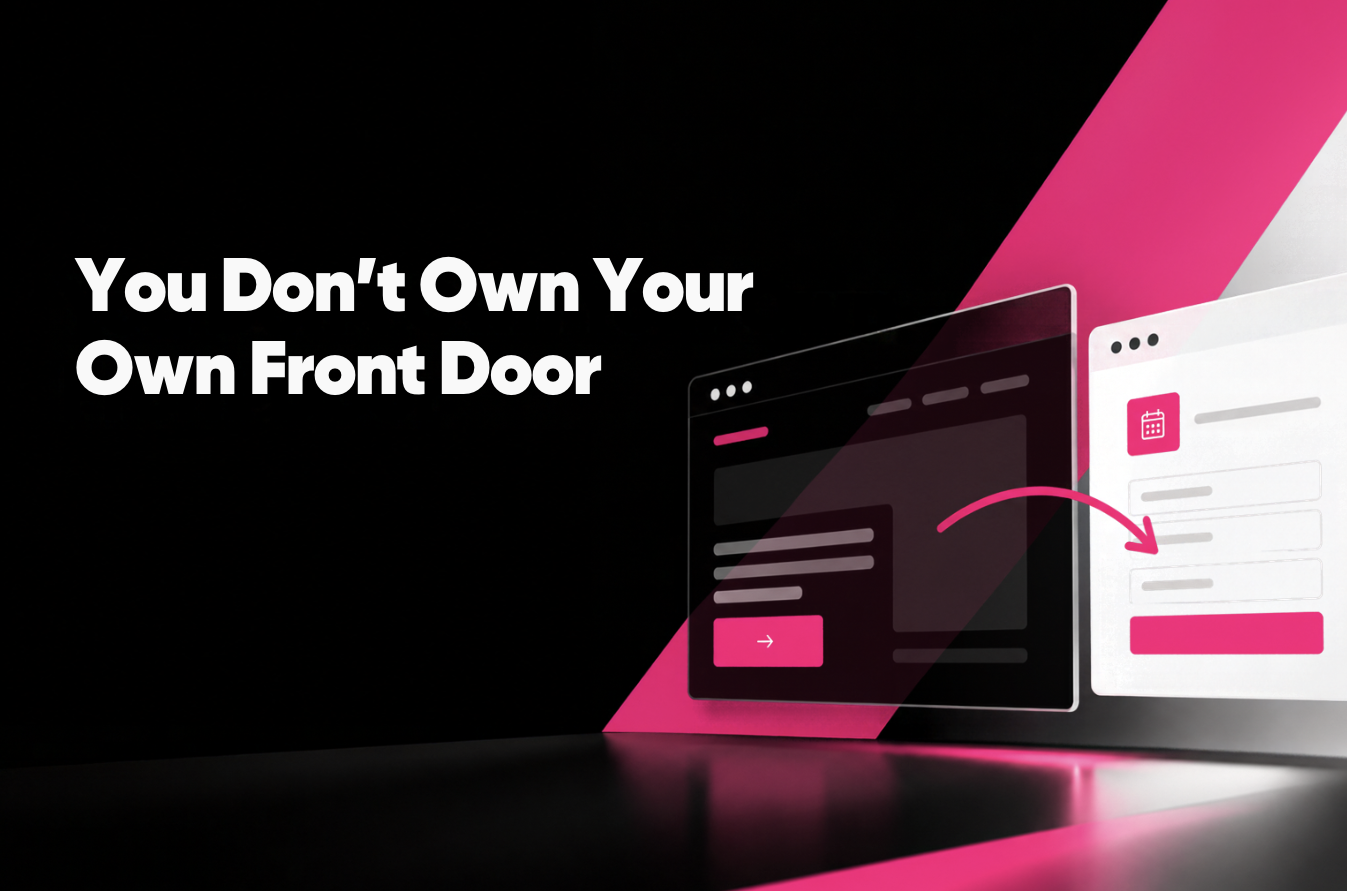
And they land on somebody else’s domain, in somebody else’s design language, answering somebody else’s idea of the right questions.
Some people don’t notice. Some do and hesitate, because it doesn’t look like the business they just decided to trust. A domain change at the exact second someone’s entering a payment method is a small trust event, and small trust events at the point of commitment aren’t small.
But the hesitation isn’t the real cost. The real cost is everything you can’t see or change.
You didn’t choose the order of the steps. You can’t test a shorter version. You can’t tell where people abandon, because the analytics live in a system built for somebody else’s purposes entirely. The most consequential twenty seconds in your whole customer journey are happening in a room you’re not allowed into.
Rented Doors Get Optimized For The Landlord 🚪
This isn’t villainy on anyone’s part. A platform running checkout for thousands of businesses is optimizing for the average of thousands of businesses, and for its own needs. It has no particular reason to reflect your positioning, your offer structure, or the specific reason people pick you over the place down the road.
So the page is generic. And generic gets expensive at exactly the moment specificity matters most. Everything upstream of that click — the authority work, the consistency, the money you spent on discovery — funnels into a page that could belong to anybody.
There’s a second cost that shows up later and hurts more.
When the front door belongs to a vendor, your ability to change how you sell is capped by that vendor’s roadmap. You want to test a different offer, a different sequence, a different way of framing the choice. You can’t, because the page isn’t yours. Your growth strategy quietly becomes a subset of somebody else’s product decisions.
Owning The Door Means Owning The Evidence 📊
The reason to care isn’t aesthetic. It’s evidentiary.
Discovery and evaluation happen out in the world where you can’t watch. The front door is the first moment the journey becomes visible to you. Give that away and you’ve given away your first clear look at your own customers.
You can’t tell which campaigns produced people who actually finished, only which ones produced people who clicked toward the door. You can’t tell whether a drop is a demand problem or a friction problem. You’re running a business off the last visible checkpoint before the one that matters.
Owning it closes that gap. Your domain, your design, your questions, your ability to test — and your data landing in your systems from the moment of intent, instead of arriving later as a settled record from someone else’s database.
Own The Experience, Connect The Machinery ⚙️
The objection is always the same, and it’s a fair one. The back-office system is the system of record and it has to stay that way.
Agreed. Nobody’s suggesting you rebuild your operations software. Memberships, schedules, inventory, billing — all of that should keep living exactly where it lives.
The distinction that matters is between the experience layer and the system of record.
The experience layer is the pages, the flow, the sequence, the words, the design, the moment of commitment. That should be yours. The system of record is the operational truth underneath, and it should stay put. The two get connected so pricing and availability stay live and a completed signup lands where it’s supposed to, automatically.
Five years ago that was a real engineering project. It isn’t anymore. Software has gotten much better at talking to other software, and the practical upshot is that owning your front door no longer means running a parallel database or reconciling two versions of the truth.
You can control the experience and still let the back office be the back office.
Go Walk Your Own Door 🔎
Do it on your phone, as a stranger, from an ad or a search result all the way to the point of paying.
Count the domain changes. Count the fields. Notice where the design stops looking like you. Notice how many steps exist to serve the software rather than the customer.
Most owners haven’t done this in over a year and are quietly appalled when they do.
The good news is this is the cheapest leak in the funnel to fix. Authority takes quarters to build. A front door can be rebuilt in weeks, and the effect shows up immediately in the only numbers that count.