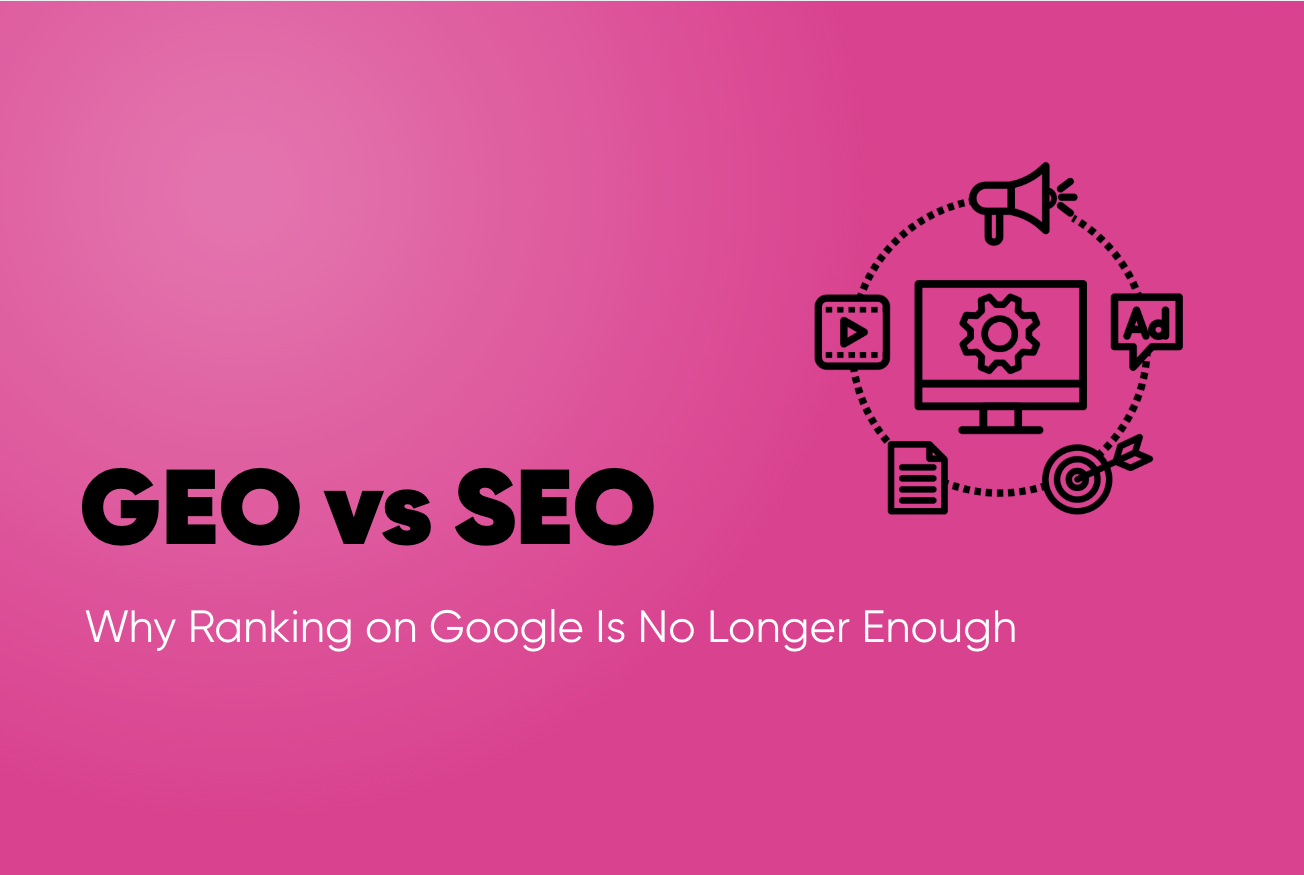
GEO vs SEO: Why Ranking on Google Is No Longer Enough
For the past twenty years, digital marketing has focused on a single main objective: Achieving high Google search rankings. Businesses invested heavily in: SEO agencies Backlinks Keywords Metadata Blog content Google Business Profiles This approach was effective for many years.
For the past twenty years, digital marketing has focused on a single main objective:
Achieving high Google search rankings.
Businesses invested heavily in:
- SEO agencies
- Backlinks
- Keywords
- Metadata
- Blog content
- Google Business Profiles
This approach was effective for many years. However, the rise of digital behaviors is changing how businesses are discovered online.
Search behavior is evolving more rapidly than many firms recognize.
Consumers no longer rely solely on Google to find businesses.
Today, people are asking:
- ChatGPT
- Gemini
- Claude
- Perplexity
- AI assistants built into phones and browsers
These are questions that previously would have been entered directly into a search engine.
This shift fundamentally changes the rules of digital discovery.
A business may rank highly on Google yet remain invisible within AI-driven discovery platforms.
This is why GEO, or Generative Engine Optimization, is emerging as an important development in digital marketing.
What Is GEO? 🔍
GEO stands for Generative Engine Optimization.
Rather than focusing exclusively on search engines, GEO optimizes your business for AI systems so they can:
- Understand your business
- Trust your business
- Reference your business
- Recommend your business. This approach requires a fundamentally different mindset.
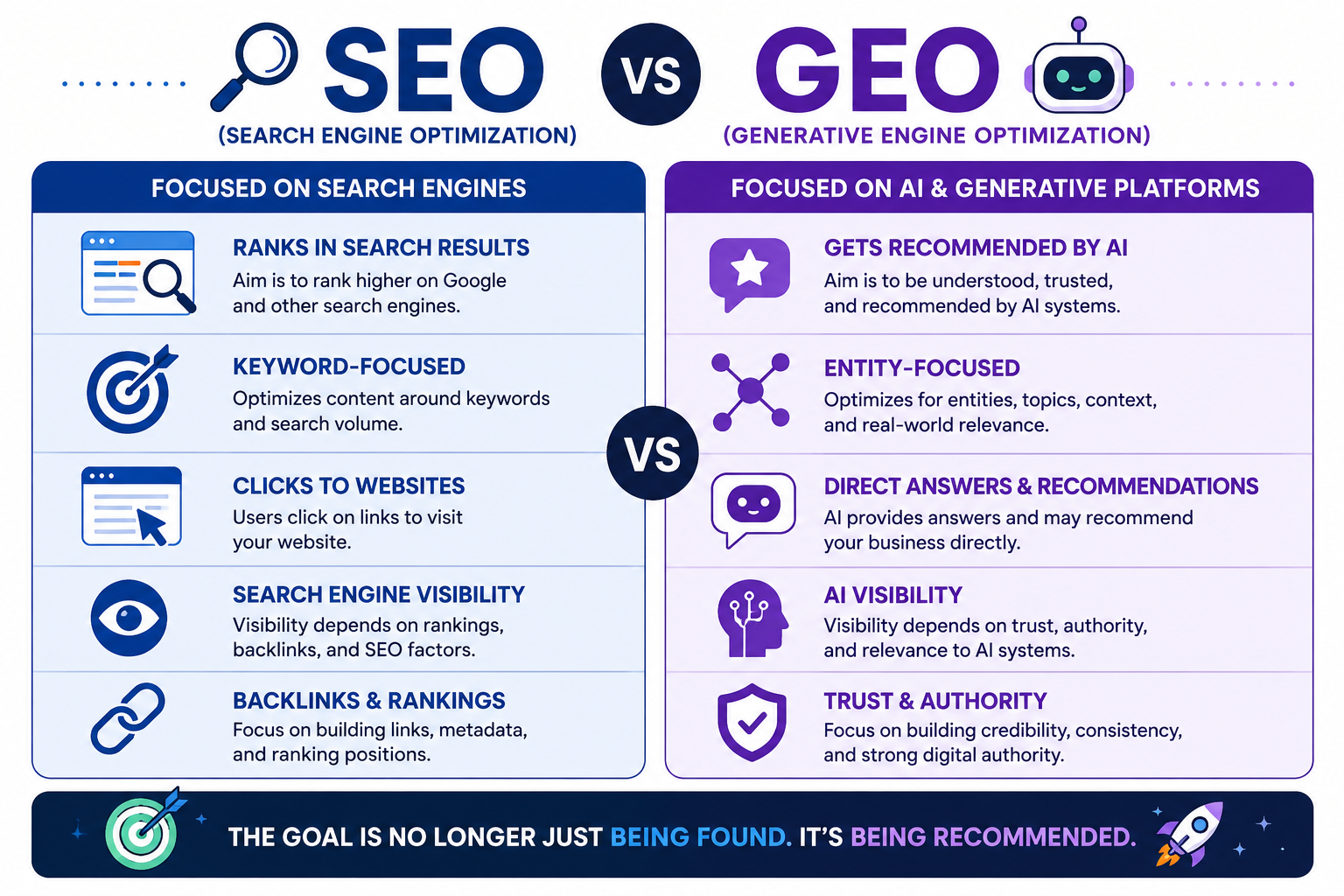
Traditional SEO was heavily focused on:
- Keyword density
- Link building
- Ranking positions
GEO focuses more heavily on:
- Entity recognition
- Structured information
- Trust signals
- Authority
- Consistency
- Semantic connections
- Conversational relevance
To summarize, SEO improves search result rankings for keyword-based queries, while GEO ensures businesses are understood, trusted, and recommended by AI systems that respond directly to user questions.
GEO enables businesses to provide AI-generated responses to user inquiries, whereas SEO focuses on visibility in traditional search results.
Why Most Businesses Are Not Prepared ⚠️
Most local businesses still have websites that were built primarily for humans and traditional search crawlers.
However, AI systems assess businesses using different criteria.
AI systems have difficulty with websites that:
- Have poor structure
- Use generic content
- Lack of authority signals
- Have inconsistent information online
- Fail to demonstrate expertise.
This delivers a significant opportunity for businesses that adapt early.
Currently, most industries have yet to adapt to these changes.
What GEO Actually Looks Like 🤖
At Sneeze It, we are already observing the growing importance of AI visibility. Long digital authority tends to:
- Appear more often in AI-generated recommendations.
- Show up in conversational search results.
- Build trust faster
- Benefit from wider digital visibility
GEO strategies often include:
- Structured website architecture
- FAQ optimization
- Schema markup
- Consistent branding across platforms
- Review optimization
- Authority-building content
- Semantic website organization
The goal is not to manipulate AI systems.
It is about making your business easier for AI systems to accurately understand and trust.
The Future of Search Is Changing 🚀
The most significant mistake companies can make now is assuming that traditional SEO alone will ensure future success.
Google is still important.
However, Google is no longer the sole gatekeeper.
Companies that adopt GEO early will likely gain substantial visibility advantages over competitors who rely on outdated search strategies. We believe businesses need to prepare now—contact us today to discuss how you can adapt your strategy before the shift becomes obvious to everyone else.
By the time AI-driven discovery is widely acknowledged as the new standard, early adopters will have already established a strong presence.