How Slow Follow-Up is Inflating Your Cost Per Lead Without You Knowing It
When cost per lead starts creeping up, most businesses assume the problem lives inside the ad account. They attribute the decline to competition, seasonality, creative fatigue, or platform changes.
When cost per lead starts creeping up, most businesses assume the problem lives inside the ad account. They attribute the decline to competition, seasonality, creative fatigue, or platform changes. What almost no one considers is that the real cost increase may be happening after the lead comes in, not before.
🚀 The Algorithm Is Always Watching
Ad platforms do not operate in a vacuum. They learn from what happens to the traffic they send. When a lead submits a form or makes a call, the platform monitors signals to determine whether the interaction was meaningful. Fast contact, honest conversations, and follow-through send one message. Silence sends another. Slow follow-up signals to the system that the leads it delivered did not yield meaningful results.
💸 How Costs Quietly Increase
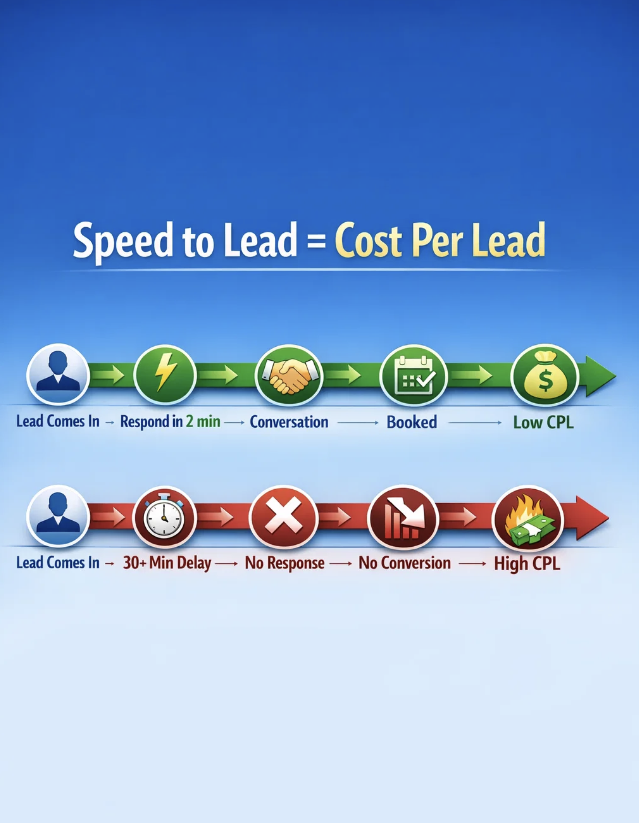
This is where cost per lead gets quietly inflated. When leads sit untouched for ten minutes, thirty minutes, or longer, intent decays. Fewer conversations happen. Fewer appointments are booked. From the platform’s perspective, the outcome looks weak. In response, it either searches harder for people likely to convert, which raises costs, or it delivers lower intent traffic that behaves similarly to what it has already seen. Either way, efficiency drops.
📉 The Misleading Dashboard Problem
The frustrating part is that dashboards do not show this. You see rising CPL and assume the ads are underperforming. In reality, the ads may be doing their job perfectly. The breakdown is timing. Two businesses can run identical campaigns and see dramatically different costs simply because one responds quickly and the other does not.
🔄 The Downward Spiral
Slow follow-up also creates a compounding problem. As costs rise, teams often reduce budgets or chase cheaper leads. That leads to lower-quality traffic, which performs worse when paired with slow response times. The cycle reinforces itself, and performance continues to decline without a clear root cause.
⚡ What Actually Fixes It
Businesses that fix this rarely start with new ads. They begin with response discipline. Clear ownership of inbound leads. Immediate acknowledgment. Consistent first contact within minutes, not hours. When that happens, conversion rates improve, signals clean up, and the algorithm adjusts. Costs stabilize because the system sees resolution instead of dead ends.
⏱️ Speed Is Your Hidden Cost
If your cost per lead keeps rising and nothing in the ad account explains it, look at the clock. The most expensive part of your funnel may be the time between when someone raises their hand and when someone responds.