Blog Playbooks · The Multi-Location Playbook · Part 3
How to see which brands AI recommends in every market you serve
Ask ChatGPT, Google and Perplexity the questions your customers ask, city by city, and read the sources behind each answer. Here is a monthly category check a multi-location brand can run in an afternoon.
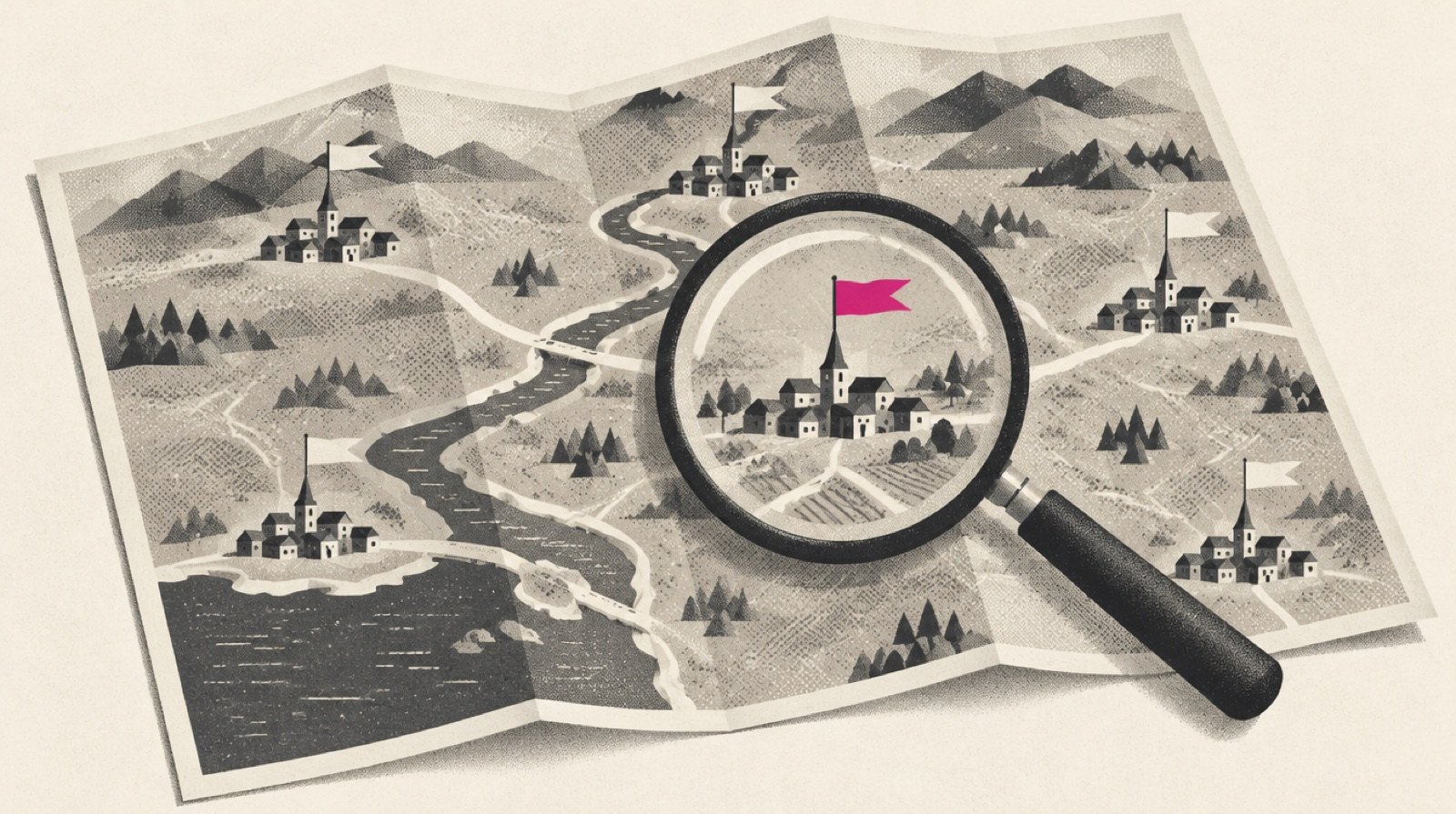
A franchisor with 30 locations does not have one AI reputation. It has 30 of them, one per market, and in each market the assistant is choosing between you and the studio down the street. The question we see in our own search data is a direct one: how can companies see which brands AI recommends?
None of the platforms we cover here offers a report that lists every brand an assistant named in your category in Tampa last Tuesday. You can see it the way your customers do: ask. Done on a schedule, market by market, with the sources written down, that becomes a category map you can act on.
We already wrote the single-business version, ask the AI about your business before your customers do. That check asks what the assistant says about you. This one asks who it recommends instead of you, in every market you serve, and why.
Where the recommendations come from
The second question in our data is "which sources shape how AI recommends a brand right now?" Each platform's help pages describe part of the answer.
Google. Google's Search Central page on AI features says AI Overviews and AI Mode "may use a 'query fan-out' technique," issuing "multiple related searches across subtopics and data sources" to build a response. To show as a supporting link, a page "must be indexed and eligible to be shown in Google Search with a snippet." Google adds that there are "no additional requirements" and no special schema to add. The two features "may use different models and techniques, so the set of responses and links they show will vary."
ChatGPT. OpenAI's help page on web search says ChatGPT "sometimes partners with other search providers" and "typically rewrites your query into one or more targeted queries." It "may use an approximate location based on your IP address." Its own example: "good restaurants near me" from the San Francisco area may become "top restaurants San Francisco." For businesses that claim a profile in Business Hub, OpenAI says ChatGPT "may also use other sources when answering questions about your business."
Perplexity. Perplexity's help center says it searches the internet in real time and that "each answer includes numbered citations linking to the original sources."
Two platforms also say what does not count. Google: "Paid advertising does not influence the organic responses generated by Google AI." OpenAI: "Advertising doesn't influence ChatGPT's independent answers."
- 1The questionA customer asks for the best option near them
- 2The locationNamed in the question, or inferred from the device or IP
- 3The searchesThe assistant runs its own related searches
- 4The sourcesPages it can read: sites, listings, reviews, articles
- 5The answerA short list of brands, with links to its sources
In practice, the signals are the pages an assistant can find and read when it runs those searches, which is why the source list in your check matters more than the brand list.
The monthly category check, market by market
- Pick your markets
Start with five: your two strongest, your two newest and one that is struggling. Rotate the rest through the quarter.
- Write three category questions per market
Use customer words and name the city or neighborhood: "best reformer Pilates in South Tampa," "kids swim lessons near Plano with weekend classes," "med spa for facials in Scottsdale that takes walk-ins." None of them names your brand.
- Ask three assistants
ChatGPT with search on, Google (the AI Overview if one shows, and AI Mode), and Perplexity. Naming the city in the question keeps the answer from depending on where you sit. OpenAI notes that a VPN or saved memory can affect location, and suggests asking it "to search again using a specific source, date, or location" when a result looks wrong.
- Record the brands, in order
For each answer, list every brand named and its position. Mark whether your location appears and which competitors appear in its place.
- Record the sources
In ChatGPT, open the more options menu on the answer and select View sources. In Google, open the supporting links. In Perplexity, open the numbered citations. Write down the domain of every source: your site, a directory, a review site, a local article, a competitor.
- Read your own data
In Search Console, Google counts AI Overviews and AI Mode traffic inside the Performance report under the "Web" search type, not in a separate row. If you have claimed your brand in ChatGPT's Business Hub, open Insights.
- Compare markets
Put every market in one sheet. Look for the source domains that keep showing up where you lose and are missing where you win.

Business Hub is the one place where the numbers come from inside an assistant. After your claim and identity verification are approved, Insights show "aggregate activity over the past 28 days," including mentions and website clicks. For a local business, "a mention counts when ChatGPT shows a result for that location." Discovery topics group "common themes in ChatGPT answers that mentioned or cited your business," but OpenAI says they "don't reveal individual prompts." A blank metric "doesn't necessarily mean zero activity."
Multi-location brands should know how profiles are organized. OpenAI says "each distinct brand has its own profile" and there is "no single parent profile that manages every brand or automatically claims its locations." For brands using a managed claim process, "individual location profiles remain locked by default." Local stores "can currently claim only an existing U.S. listing." We walk through the claim in how to claim and manage your ChatGPT business profile.
Checking your own name
Asks what the assistant says about your brand. Finds wrong hours, old prices and stale offers. Fixes one fact at a time.
Checking your category
Asks who the assistant recommends instead of you, in each market. Finds the sources your competitors have and you lack. Fixes the gap across every location.
What the sources usually tell you
When you lay a month of answers side by side, the sources fall into a few groups: your own site, your listings, third-party review and directory pages, and local articles or lists. The fix depends on the group.
If the assistant cites a competitor's site and never yours, check that yours can be read. In our Agent Ready research we scanned the homepages of 98 multi-location fitness and wellness brands. The median score was 46 out of 100, and 18 of the 98 sat behind a bot wall. Google's own page lists "ensuring that crawling is allowed in robots.txt, and by any CDN or hosting infrastructure" as a basic. We wrote up the full results in we scanned 98 fitness and wellness websites.
Source: Sneeze It Agent Ready research, and OpenAI Help Center, read November 25, 2026
If the assistant cites a directory or a local list where you are missing or out of date, that is a listing task for the location, not a brand campaign. If it cites reviews, the market with fewer or older reviews is the one to work on first. For the step-by-step on earning citations, see how to get cited in AI search.
The brand list tells you who won the market this month. The sources tell you why.
Expect the answers to move. Google says AI Mode and AI Overviews show different sets of links, and ChatGPT rewrites each question its own way. One month of answers is a snapshot. Three months of the same questions in the same markets is a trend you can manage.
Sources
- Google Search Central, "AI features and your website," https://developers.google.com/search/docs/appearance/ai-features, last updated December 10, 2025, read November 25, 2026.
- Google Ads Help, "About ads in AI-powered experiences in Google Search," https://support.google.com/google-ads/answer/18826097?hl=en, read November 25, 2026.
- OpenAI Help Center, "Searching the web with ChatGPT," https://help.openai.com/en/articles/9237897-chatgpt-search, read November 25, 2026.
- OpenAI Help Center, "Setting up your business on ChatGPT" (Businesses in ChatGPT), https://help.openai.com/en/articles/20001635-businesses-in-chatgpt, read November 25, 2026.
- Perplexity Help Center, "How does Perplexity work?" https://www.perplexity.ai/help-center/en/articles/10352895-how-does-perplexity-work, read November 25, 2026.
- Sneeze It, Agent Ready research: 98 US multi-location fitness and wellness brand homepages scanned, October 2026.