How to Make Your Marketing Brain SmarterHow to Make Your Marketing Brain Smarter: The Secret to Scaling Without Wasting Resources
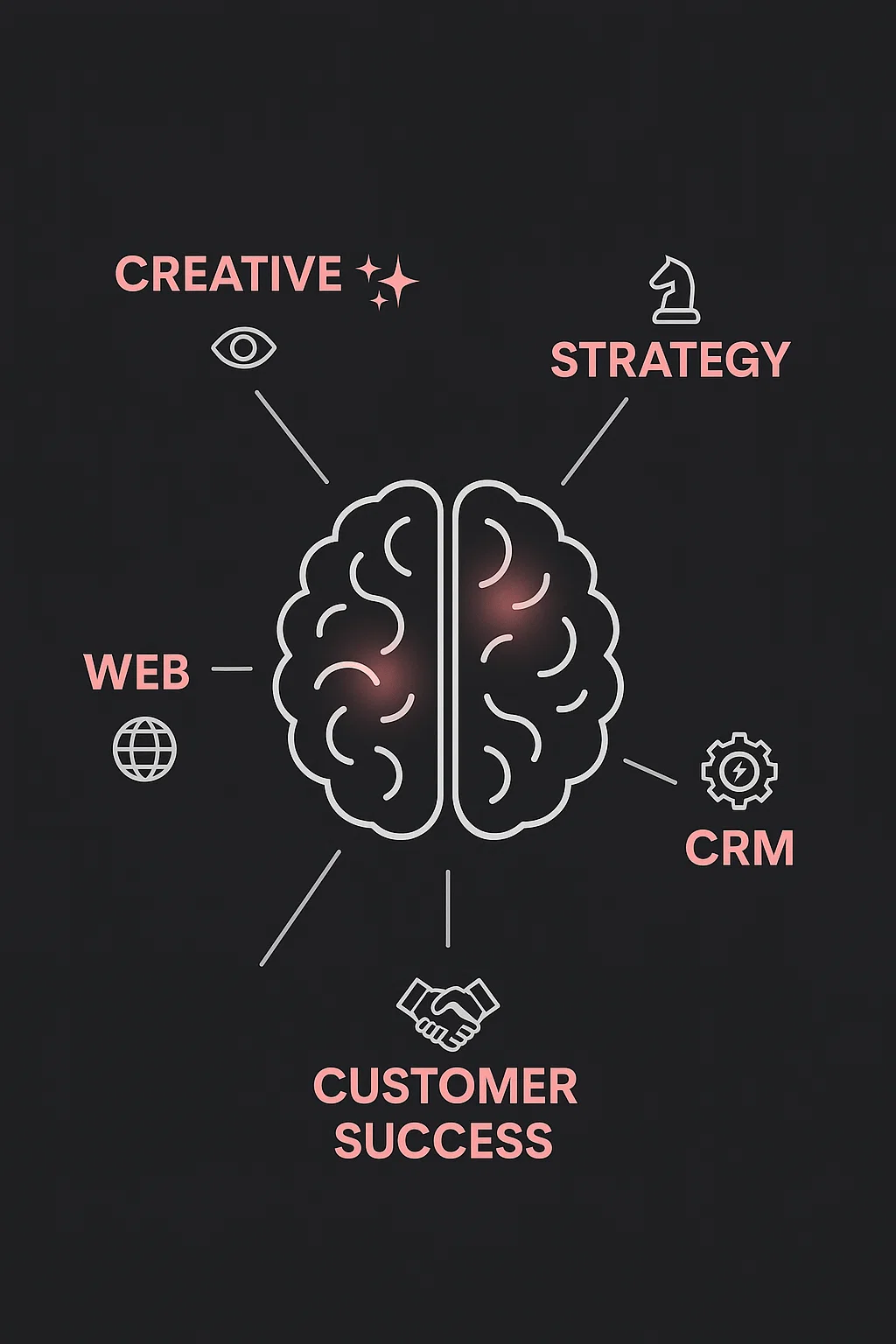
At Sneeze It, we think of our company as a brain. Every department plays a different role in how we think, act, and perform for our clients: 👁️✨ CREATIVE is the voice and visuals that grab attention.
At Sneeze It, we think of our company as a brain. Every department plays a different role in how we think, act, and perform for our clients:
👁️✨ CREATIVE is the voice and visuals that grab attention.
♟️🧭 STRATEGY is the decision-making center that directs where campaigns run and how they attract leads.
🌐💻 THE WEB is the destination and measurement hub that converts clicks into paying customers.
🤖⚡ CRM & AUTOMATION are the neural pathways that keep everything firing on time and in sync.
🤝🏆 CUSTOMER SUCCESS is the framework that ensures our clients’ goals aren’t just met – they’re exceeded.
Like in a brain, these parts constantly communicate—and sometimes compete for attention and resources. The challenge is ensuring every part of the brain works together at peak performance, especially when resources are limited.
Why Scalability Demands Simultaneous Execution ⏱️📊
Many marketing campaigns follow a linear process: we build creative, launch ads, optimize… and so on. But in today’s fast-paced environment, linear execution leaves money on the table.
For a campaign to scale effectively, every part of the marketing “brain” must fire simultaneously:
Creative and strategy development in parallel.
Landing pages and tracking are ready before the first ad goes live.
CRM workflows are in place to respond instantly to leads.
Success teams are ready to measure results from day one.
This kind of simultaneous execution creates momentum that compounds results instead of waiting for one step to finish before the next begins.
Measuring What Matters 💡🎯
We’ve all heard the adage about Cost Per Lead (CPL) being the benchmark. CPL is important – but it’s only part of the story. The real game-changer is tracking Cost Per Acquisition (CPA) – the cost of acquiring a paying customer.
That means looking beyond “How many leads did we get?” to asking:
How many of those leads became paying customers?
How long did it take to acquire them?
How much revenue did each acquisition generate compared to the cost?
How long have they been in the pipeline before converting?
By focusing on Cost Per Acquisition, you measure the actual efficiency of your marketing spend.
Resource Allocation: The Marketing Version of the Trolley Problem 🤔⚡
Here’s a thought experiment: imagine a train headed toward 20 people. You can pull a switch to divert it toward one person. What do you do?
In marketing, the “20 people” are your most valuable outcomes – the customer acquisitions that drive growth. The “switch” allocates your limited budget, time, and energy. The smartest marketing brains learn to direct resources toward the activities with the most significant impact, even if it means making tough choices.
How We Apply This Thinking for Clients 📈🛠️
When we partner with a client, we’re constantly asking:
Which areas of the campaign are delivering the highest ROI?
Where can we reallocate resources for bigger gains?
How do we shorten the gap between generating a lead and making a sale?
By treating your marketing as a connected brain and ensuring every part is firing together, you can scale faster, spend smarter, and achieve more – without burning resources.
🧠 Final Thought:
Marketing isn’t just about getting more leads; it’s about getting the right customers at the correct cost – and making every part of your marketing brain work together in perfect sync to make it happen.