The AI marketing funnel: what changes at each stage, and what to measure
For a membership or multi-location business, the funnel still runs from discovery to the join. AI now does work at every stage. Here is what changes at each one, and the number to watch.
Updated November 25, 2026. We first published this in August as a three-stage sketch. This version is the practical answer for a membership or multi-location business: the stages of the AI marketing funnel, what AI now changes at each one, and the number to watch at each stage.
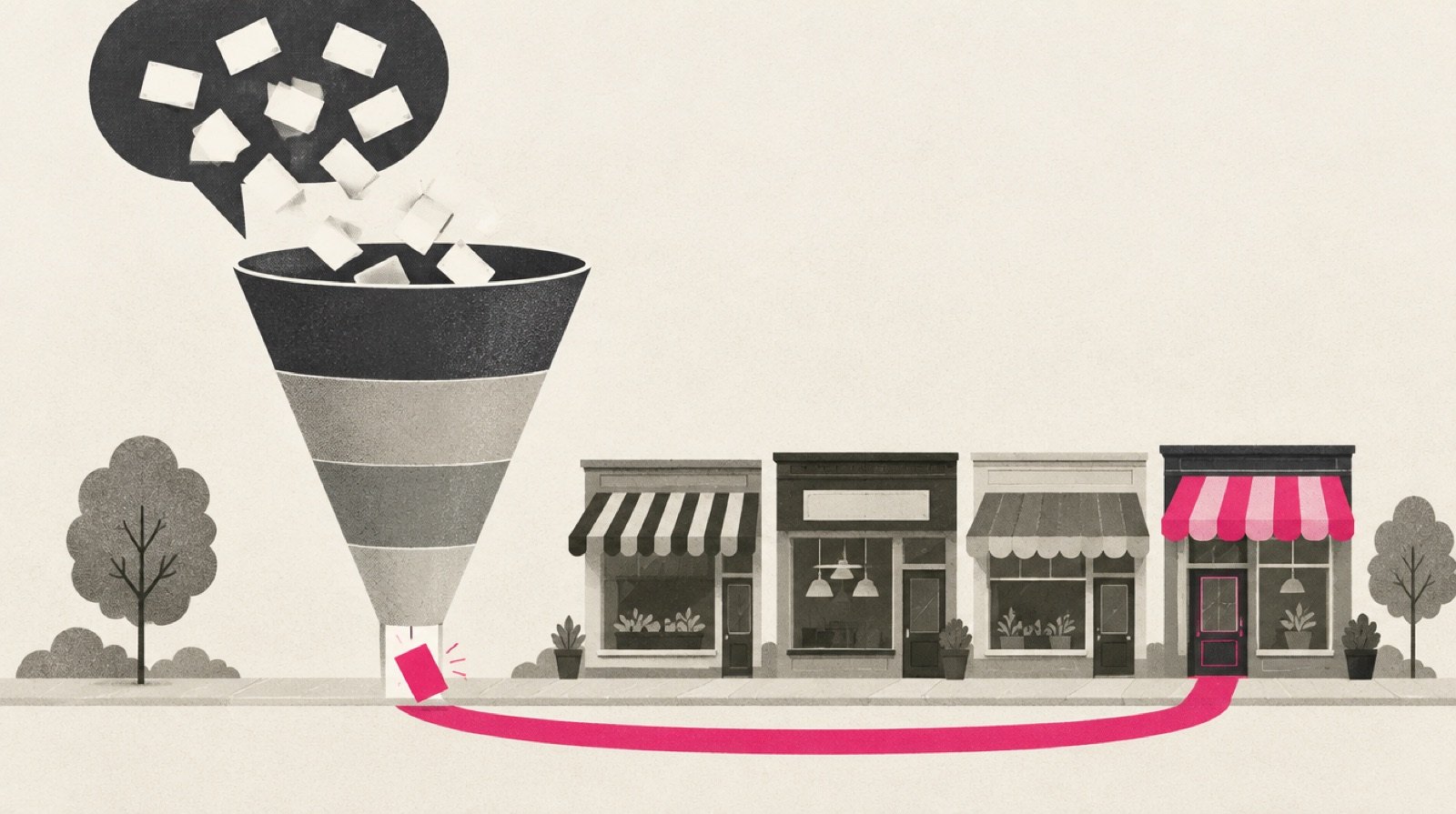
The stages have not changed much. Someone finds you, checks you out, raises a hand and, if you do your job, joins. What has changed is who does the work at each step. An AI assistant can now run the first searches for a customer, read your listings for them, and in some cases book the appointment. A searcher's funnel that used to start on a results page now often starts inside an answer.
For a brand with many locations, that means the funnel runs location by location, and the parts AI touches are the parts you see least.
- 1DiscoverAn AI answer or a search names a few options
- 2EvaluateThe customer, or the assistant, reads reviews, listings and your site
- 3BookA form, a call or an AI booking reaches one location
- 4Join and stayThe first visit becomes a membership, and the membership lasts
Stage 1: Discover. The answer comes before the click
What AI changes. Google says its AI Overviews and AI Mode "may use a 'query fan-out' technique," issuing "multiple related searches across subtopics and data sources" to build a response. To be a supporting link, a page "must be indexed and eligible to be shown in Google Search with a snippet." ChatGPT's search "typically rewrites your query into one or more targeted queries," and OpenAI says ChatGPT reaches 1.2 billion people a week. Paid placements now sit there too: Google says Search, Shopping and Performance Max campaigns "are automatically eligible to serve ads within AI Overviews and AI Mode."
What to measure. You will not get a clean report for this stage. Google counts AI Overviews and AI Mode traffic inside the Search Console Performance report, under the "Web" search type, and reports ads in those placements "in aggregate" with your other campaign results. If you claim your business in ChatGPT's Business Hub, it shows mentions and website clicks over the past 28 days, once activity passes OpenAI's reporting thresholds. Fill the gap with a monthly check: ask the assistants your customers' questions in each market and record who gets named. We lay out that check in how to see which brands AI recommends, and the fixes in how to get cited in AI search.
Stage 2: Evaluate. The assistant reads what you publish, and what others publish about you
What AI changes. The customer still reads reviews, but now an assistant often reads them first. OpenAI says that even after a business claims its profile, ChatGPT "may also use other sources when answering questions about your business." Google lists "checking that your Merchant Center and Business Profile information is up-to-date" among its basics for AI features. If an assistant cannot reach your site, it cannot read it: when we scanned 98 multi-location fitness and wellness homepages with Agent Ready, 18 of the 98 sat behind a bot wall.
What to measure. Per location, every month: new reviews divided by customers served, the median time to reply, and whether the hours, prices and booking link on each profile match your own record. We cover the review routine in Google reviews at franchise scale.
Source: OpenAI; OpenAI Help Center; Sneeze It Agent Ready research, October 2026; TikTok Business Help Center, read November 25, 2026
Stage 3: Book. The hand-raise has to reach one location, fast
What AI changes. More of the hand-raise now happens off your website. Google's AI Mode can look for open appointments and hand the customer to a booking partner, and for beauty and wellness that started with US Search Labs users. Google's help page says that if a business works with online booking providers, "Google may book through the partner or by calling your business directly." Lead forms on social platforms keep the lead in their own systems: TikTok says Ads Manager "only stores lead data for 90 days," and only admins can download leads.
AI can also make the callback, with rules attached. In 2024 the FCC confirmed that the TCPA's limits on "artificial or prerecorded voice" calls cover "current AI technologies that generate human voices," which means prior express consent. This is not legal advice; we explain what it means for a front desk in should a gym use an AI receptionist?
What to measure. Leads by location, the minutes from form to first call, and bookings. Google's Business Profile "Bookings" metric counts completed bookings only when they run through a booking provider. We call every lead inside 5 minutes of the form fill, because a lead that sits in a platform inbox until Monday has usually booked somewhere else. Our TikTok lead alerts playbook shows the routing.

Stage 4: Join and stay. Send the result back
What AI changes. The ad platforms' bidding systems learn from what you tell them. Google recommends "accurate first-party conversion measurement (via Google tag or offline conversion imports)." OpenAI's ChatGPT Ads accept conversions through its Pixel or Conversions API. Send only form fills, and the systems learn to find more form fills. Send bookings and joins by location, and they learn from the outcome you care about.
What to measure. Joins by location, first-visit show rate, and the share of new members still active after their first months. These live in your CRM and membership system, not in any ad platform. That is the reason the CRM sits at the bottom of this funnel: it is the first place the whole journey becomes visible.
The funnel most reports show
Impressions, clicks and form fills, by platform. AI answer traffic blended into search. Leads counted when they arrive. Every location averaged into one number.
The funnel to manage
Named in AI answers per market. Reviews and listings that match. Minutes to first call and bookings, by location. Joins and retention sent back to the ad platforms as conversions.
AI handles more of the top of the funnel. The bottom of it, the call, the visit and the join, still decides whether any of it paid off.
Connect the stages, or you are guessing
Most teams measure each stage in its own tool. Discovery lives in Search Console, evaluation in a review dashboard, booking in the CRM, joins in the membership system. It is hard to say which campaign produced a member. Connecting them is mostly plumbing: one location code on every link and form, one record per location, and booked, showed and joined events sent back to the platforms. Once that is in place, a weekly report per location can show the whole funnel on one page. We describe the measurement side in how to track ads in AI answers.
Sources
- Google Search Central, "AI features and your website," https://developers.google.com/search/docs/appearance/ai-features, read November 25, 2026.
- Google Ads Help, "About ads in AI-powered experiences in Google Search," https://support.google.com/google-ads/answer/18826097?hl=en, read November 25, 2026.
- Google Business Profile Help, "Understand your Business Profile performance & insights," https://support.google.com/business/answer/9918094?hl=en, read November 25, 2026.
- Google Business Profile Help, "About automated calls and texts from Google to your business," https://support.google.com/business/answer/7690269?hl=en, read November 25, 2026.
- Google, "New ways to plan travel with AI in Search," November 17, 2025. https://blog.google/products-and-platforms/products/search/agentic-plans-booking-travel-canvas-ai-mode/
- OpenAI, "Introducing Businesses in ChatGPT," November 10, 2026. https://openai.com/index/introducing-businesses-chatgpt/
- OpenAI Help Center, "Setting up your business on ChatGPT," https://help.openai.com/en/articles/20001635-businesses-in-chatgpt, read November 25, 2026.
- OpenAI Help Center, "Searching the web with ChatGPT," https://help.openai.com/en/articles/9237897-chatgpt-search, read November 25, 2026.
- OpenAI Help Center, "Conversion Measurement," https://help.openai.com/en/articles/20001409, read November 25, 2026.
- TikTok Business Help Center, "How to access leads data," https://ads.tiktok.com/help/article/access-leads-data-in-leads-center?lang=en, read November 25, 2026.
- Federal Communications Commission, Declaratory Ruling FCC 24-17, released February 8, 2024. https://docs.fcc.gov/public/attachments/FCC-24-17A1.pdf
- Sneeze It, Agent Ready scan of 98 US multi-location fitness and wellness homepages, October 2026. Read the study